Showing posts with label japanese. Show all posts

Thursday, November 29, 2012

Yakisoba (with a few variations)

It's been ages since my last post simply due to my consistently forgetting to take pictures. But, yesterday, a lovely friend (Rosie dearie I mean you!) reminded me and I actually took pictures. Enough picture, in fact, for a step by step recipe post.

Yesterday, I needed a quick recipe to make because I was running out of time to make supper. So I went flipping through my trusty recipe book "Let's Cook Japanese Food!" and landed on the recipe for Yakisoba and I remembered that we have some napa cabbage that was in dire need of being used.

I gathered everything for the meal, which isn't much: only half a head of cabbage, 1/2 a large carrot (or a whole small one), and 1/2 a yellow onion.

I chopped it all up as I thawed the pork chops. Technically the recipe in the book calls for 6 pieces of thick cut bacon, but as my family likes more meat in our dishes (and we normally don't have bacon on hand) I thaw a pork chop or two and slice them into thin pieces instead. Hey, bacon is pork after all, so it tastes the same.

So once the veggies were ready, I sliced the pork chops. I ended up only using 1 1/2 because one of them was gigantic. It was shoved back into the freezer for another day. Once sliced, I tossed the meat in a large frying pan (the key word here is large because this dish will overflow the pan if you don't use one that is big enough) with a tablespoon or two of oil.

While the pan started heating up, I pulled out two bundles (3.5 oz each dry) of soba noodles. This is only about half the noodles that the recipe calls for, but I know from cooking this before that 1) we don't need all those noodles and 2) they typically make the pan overflow. I used normal soba noodles, but yakisoba noodles are best.If you have neither, spaghetti noodles work great. But, soba noodles of some form are the best. So, I boiled the noodles until al dente and quickly drained them. You do NOT want soggy noodles. Trust me.

By the time the noodles are cooked, the pork was fairly well done so I tossed in the veggies. The recipe said to stir fry them for only around 2 minutes but I typically do it longer until I can see that the veggies are starting to soften (and that the pork is finally done).


The noodles came next and I stirred them well into the mixture. Then, I poured in the 1/4 cup water and covered it for the minute in the recipe and then stirred until the water boiled off.


The final step is the fun one where you season it to taste. I've never managed to find Yakisoba sauce which is ideal (if you have it, use 1-2 tablespoons). I typically substitute 2 tablespoons Worcestershire sauce and then 1-2 additional tablespoons of soy sauce to taste. I stirred all that in, and then added a sprinkle of pepper and salt (again, do it to taste).




One final thorough stir and it was done. Doesn't it look good? The noodles were a bit soggy because I let them sit too long, but other than that it was great.

Tuesday, May 22, 2012

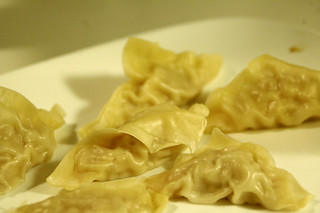
Potstickers! (aka Dumplings or Gyoza)

I mentioned having them in my last post, and last friday I finally got around to making them again. This time with a small variation - homemade wonton wrappers. They turned out really well, albeit a ton of work with the rolling pin. I followed this recipe for the wrappers. (Of course, I only needed a small amount of wrappers so I made a 1/4 recipe.)

As for the potsticker filling, I kinda make it up as I go along. This batch was made with leftovers from the last time I mixed up a batch. Usually the recipe is somewhere along the lines of:

1 lb ground pork
~1/4-1/3 head of cabbage chopped
a Tb or 2 of minced ginger (I always put in extra!)
~6 green onions minced (if I have them on hand)
Sometimes I also add in soy sauce and sake.

Then, the fun part: Mix it all up with your hands! It usually yields enough filling for around 70 potstickers. (Which is why I always have some leftover. Wonton wrappers come in packs of 50.)

And here's the result. Yummy, ne? Then you dip 'em in a mixture of soy sauce and sesame seed oil and eat until you're full.

Now, traditional japanese potstickers (gyoza) are fried in a pan until one side is crispy, but I keep forgetting to try this method of cooking. Usually I just steam them.

On a different note, I'm going to try to post once a week about asian cuisine (since that's the new direction I'm taking this blog). I should be able to keep this up since I'm already cooking it for my family once a week. Now, to remember to take pictures. I didn't remember to take any of the Omuraisu or Miso soup (w/ kale) I made tonight.

Until next time!

Thursday, August 25, 2011

The Sweet Rewards of Exploration

Since I haven't been quite as active in the area of Japanese language learning I thought I would expand this blog to include my pursuits in other areas of Japanese culture. I will feature food mainly. (These posts are double posted from my other blog on writing.)

I have a new area to explore. This hobby, though, has tasty rewards. I'm talking about the wide world and art of Japanese cuisine. Art?, you might say, but it is an art. And recently I've been experimenting in not just creating Japanese dishes but creating food art as well.
With Borders going out of business I just had to head over there myself. After scouring the picked clean shelves I found two books of interest, both in the cooking aisle and both on Japanese food. The Decorative Art of Japanese Food Carving by Hiroshi Nagashima details basic but elegant food carving. Let's Cook Japanese Food! by Amy Kaneko is beginning cookbook of Japanese recipes found on the average Japanese dining table but with a Western twist. I wish to focus on the former book for this post though. I shall leave the latter for another time.
For several years now I have been interested in Japanese culture. It began with anime and manga but certainly has not ended there. My recent novel/short story series starts off in Japan which has required much research, but even before that I had developed a taste for Japanese cuisine.
I believe it all started the first time I tasted true home cooked Japanese food. Several friends and I hung out together to watch an entire anime. We started around noon and ended at midnight when the guys were kicked out of the dorm lobby. But we decided to make supper - Japanese style. One friend had the tools to make sushi. Another pitched in miso soup and another make gyoza dumplings (potstickers). I fell in love at first taste. Though, I have come to
the conclusion that sushi is ok once in a while but I dislike how bland it is. This led me to hunt down the ingredients and the recipe for both miso soup and dumplings as well as the soup stock (dashi) recipe. Since then I've been acquiring recipes and trying them out on my poor family.
Back to the food art though. My recent urges have been to duplicate the cute food art so prominently featured in animes, namely octopus wieners and bunny apples. Along the way, I found out about another apple cutting method that makes a leaf. Based on memory and some research, I experimented with these three cutting methods. The results were fun and tasty.

Bunny Apples


Leaf Apples

I think food art is amazing and I hope that I can create more intricate designs with practice. That is one reason I bought The Decorative Art of Japanese Food Carving. I haven't tried any of the carvings yet, but I intend to as soon as I can plan a meal with sufficient time to take garnishes into account.

Until next time!

Monday, July 26, 2010

Typing in Japanese

While progressing along my Japanese language studies, I came to the realization that being able to type in Japanese (hiragana, katakana and kanji) would be very useful, especially if I was wanting to print flashcard fronts instead of handwriting the kana. Thus I started searching for a way to type in Japanese on my computer. A little searching led me to this site, “Waterford School Japanese” and it has this handy word document download that explains how to activate the Japanese language typing function on a Windows computer. It does require some knowledge of kanji to correctly type because it automatically generates the kanji based on the hiragana typed. As several words in Japanese have the same pronunciation but different kanji, the computer could insert the wrong kanji quite easily. So do be careful.

じゃまた (Jamata/See you later)!

Related Posts Plugin for WordPress, Blogger...